
The History of shocker
The Shocker holds a special place in paintball history as the first-ever electro-pneumatic paintball marker, Invented by Bill & Adam Gardner of Smart Parts, with a team of engineers from Pneu Ventures, the Shocker marked a significant turning point in the evolution of paintball markers and had a profound impact on the paintball industry.
At the time, the Autococker and Automag were the dominant forces of tournament paintball. Almost all paintball teams used one of these markers including the All Americans. At one of the industry banquets, Tom Kaye of Air Gun Designs openly discussed how he felt that paintball markers had advanced to the point where they could go no further and that the Automag and Autococker were the perfect designs. Bill & Adam did not agree and soon introduced the Shocker.
Electro-Pneumatic Innovation
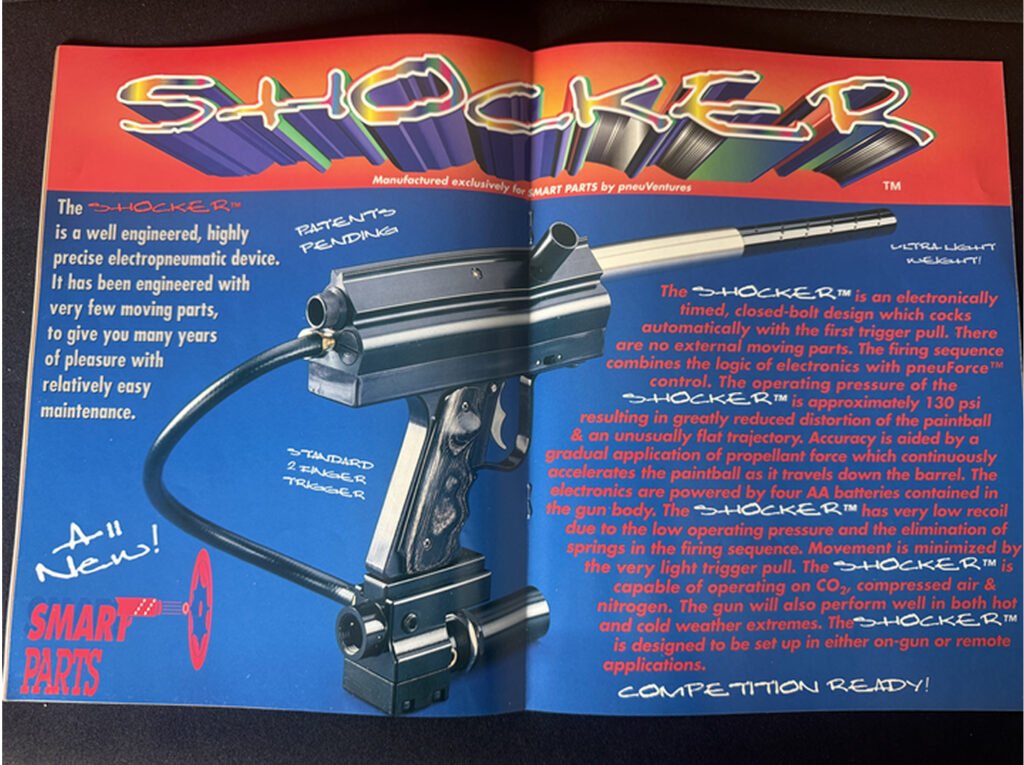
The Shocker was revolutionary because it combined electronic firing mechanisms with pneumatic operation. This meant that instead of relying solely on mechanical components, the Shocker utilized electronic solenoids to control the firing sequence, allowing for faster and more consistent shooting. The introduction of electro-pneumatic technology allowed for a higher rate of fire, improved trigger response, and enhanced overall performance compared to traditional mechanical markers.
The copycats came quickly.
There are some who will incorrectly argue that WDP introduced the first electronic marker as that is what they wanted everyone to believe. The below Affidavit from IAN (JACKO) PARSONS, formerly of WDP and currently an owner of PLANET ECLIPSE and Manager of Planet Eclipse USA puts all the doubt to rest. This is significant as Smart Part’s reputation was irreparably harmed by the misinformation and smear campaign propagated by WDP and their minions. There was a lot of money to be made on Smart Parts’ revolutionary design and WDP wanted a piece of it. This would lead to years of lawsuits and patent cases. Smart Parts would eventually prevail, but damage was done to both companies.
The success of the Shocker as the first electro-pneumatic marker set a new standard in the industry. Soon, almost all manufacturers quickly began to develop their own electro-pneumatic markers, leading to a rapid evolution in marker technology. This shift not only improved the performance of paintball markers but also influenced the design philosophy of future models, with a greater emphasis on electronic features and user customization.
Broader Industry Impact
Competitive Edge
The Shocker’s electro-pneumatic capabilities provided players with a competitive edge in tournaments. As players sought markers that could deliver higher rates of fire and improved accuracy, the Shocker became a popular choice among professional teams and players. This shift towards electronic markers helped to elevate the level of competition in the sport, as players could now shoot faster and more accurately than ever before.
Market Growth
The introduction of electro-pneumatic markers, spearheaded by the Shocker, contributed to the growth of the
paintball market. As more players became interested in the sport, manufacturers began to invest in research and
development to create their own electronic markers, leading to a wider variety of options for consumers. – This growth also helped to establish paintball as a more mainstream sport, attracting new players and sponsors.
Cultural Shift
The Shocker’s success and the rise of electro-pneumatic markers contributed to a cultural shift within the paintball community. Players began to prioritize technology and performance, leading to a greater focus on marker specifications, customization options, and competitive play. The emphasis on technology also fostered a community of enthusiasts who were eager to discuss and share knowledge about marker performance, upgrades, and innovations.

The Shocker's introduction as the first electro-pneumatic paintball marker was a groundbreaking moment in the history of the sport.
Its innovative design and performance capabilities not only set the stage for future developments in paintball technology but also transformed the competitive landscape of the game.
The Lineage
1996
PVI / pneuVentures Shocker.
What it was: The original, large “shoebox” Shocker. Electropneumatic, dual-solenoid, closed-bolt, hammerless design. The first electropneumatic paintball marker. Why it mattered: Introduced true electro control and a dump-ch
1998
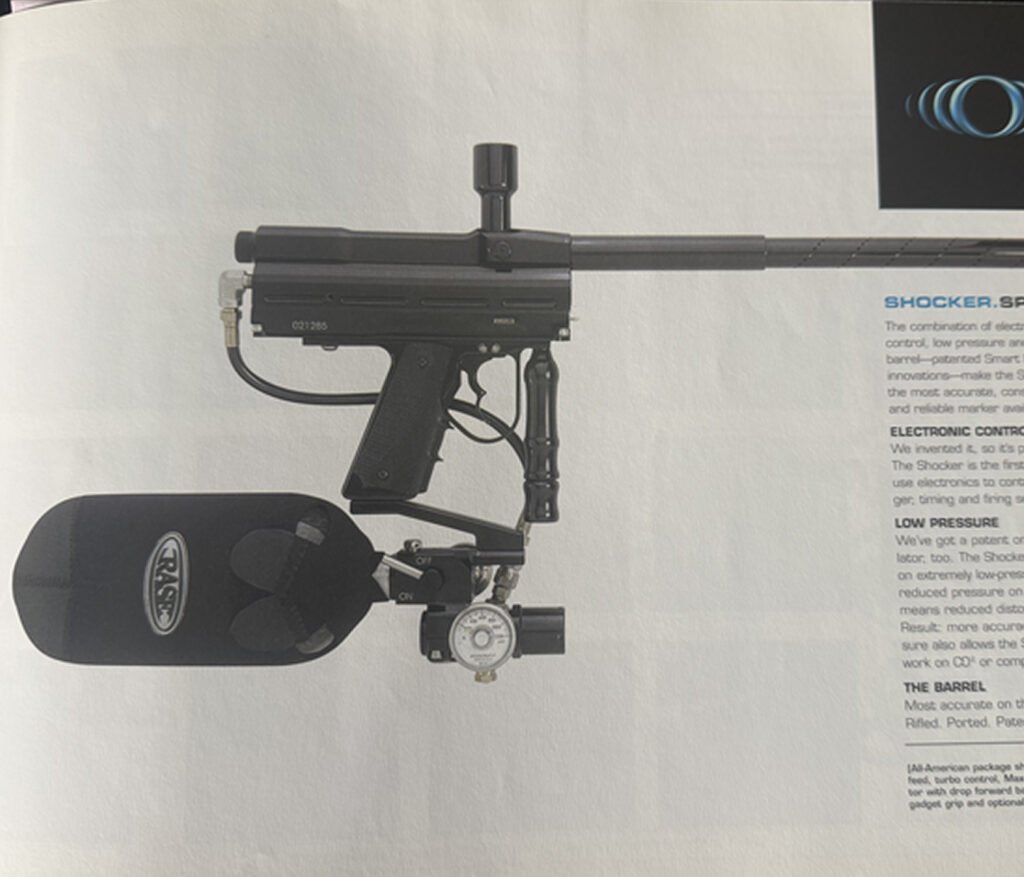
Smart Parts Shocker Sport (variants: 4x4, S/F, Turbo).
What changed vs PVI: Fully in house redesign. Lighter body, improved electronics/grounding, faster cycling and better solenoids; multiple cosmetic revisions over the run. Notable features: Turbo mode (“ramping” ancestor) available on Turbo boards; S/F added burst/full-auto modes; 4x4 was semi-only. Available in standard feed, powered or vertical feed options.
2003
Shocker SFT (“03 Shocker”; Seal Forward Technology).
Major shift: Complete ground-up redesign to a single-tube, open-bolt spool platform (totally different from the Shoebox internals). Signature tech: SFT breech seal—bolt seals the breech a split-second before firing, blending “closed-bolt-like” shot stability with open-bolt rate of fire. Other highlights: Much smaller/lighter package; performance later boosted by HE (High-Efficiency) bolt upgrades. Available in a plethora of custom milled, team and store versions, kicking off a new era of customizability and design.
2006
Shocker NXT.
What changed vs SFT: Factory refinements across the platform: updated frame/ergos, inline reg and body tweaks, detent/eye updates, and new barrel thread standard (Impulse/Ion). Why it mattered: Essentially a “production-refined SFT” with improved reliability and end user improvements. (Smart Parts filed for liquidation in 2010; the Shocker IP later returned under the Shocker Paintball/GOG family, bringing the line back years later.) Signature tech: SFT breech seal—bolt seals the breech a split-second before firing, blending “closed-bolt-like” shot stability with open-bolt rate of fire. Other highlights: Much smaller/lighter package; performance later boosted by HE (High-Efficiency) bolt upgrades. Available in a plethora of custom milled, team and store versions, kicking off a new era of customizability and design.
2016
Shocker RSX (Shocker line revival).
Big upgrades: Push-button, tool-less bolt system removal; spring-assisted latch—fast maintenance. Lever detents (low-drag, long-life), OLED interface, modern biased spool design. Why it mattered: Brought Shocker back as a compact, service-friendly high-end at a mid price.
2017
Shocker XLS.
What changed vs RSX: Longer ergonomics, lower operating pressure, shipped with Freak XL barrel system. Takeaway: An RSX refinement focused on feel/pressure/accuracy updates and modern barrel standard.
2017
Shocker AMP (Advanced Modular Platform).
Major upgrades: Completely redesigned bolt & valve with about ~20% efficiency gain vs XLS. Twist-lock, tool-less bolt; very low operating pressure (~110 psi) for gentle paint handling. Water-resistant electronics and a zero-pinch, plug-in wiring layout (dual-board architecture). Fast mech conversion via the optional CC (Classic Conversion) frame; toolless solenoid removal aids the swap.
2023
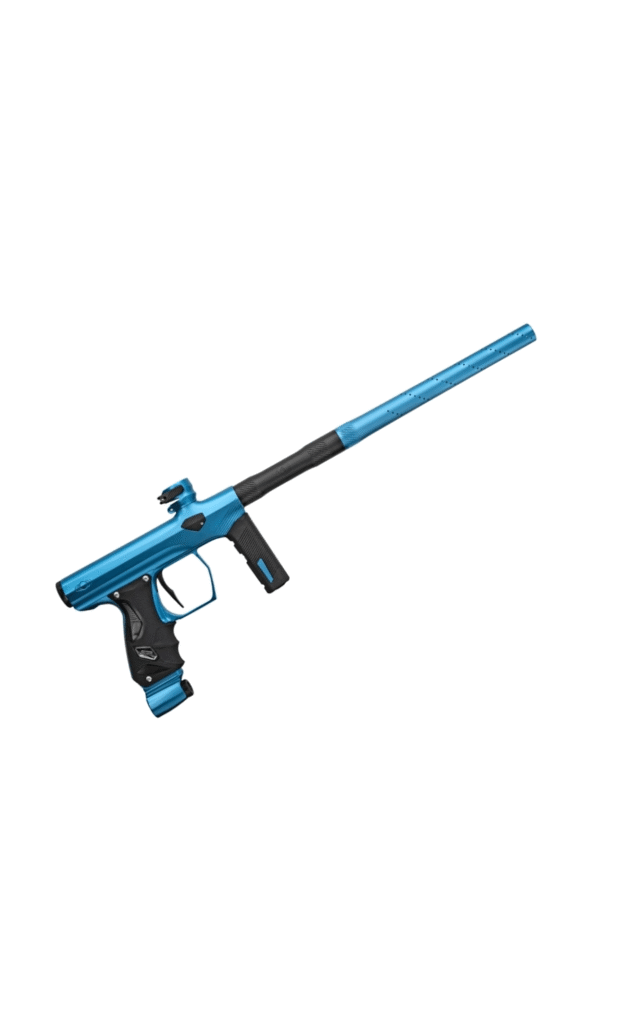
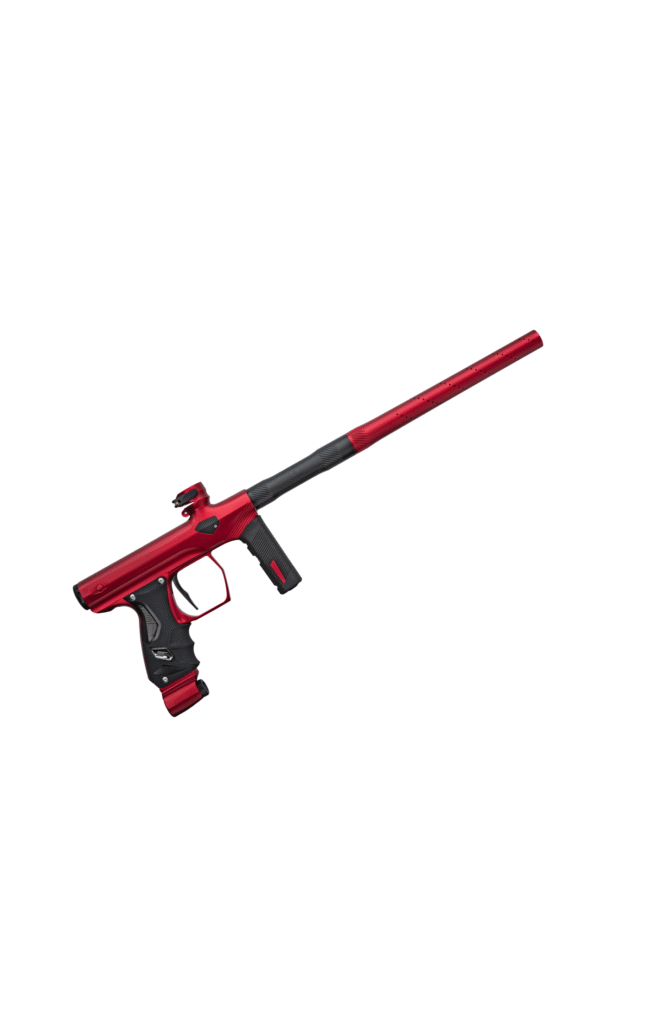
Shocker ERA
What changed vs AMP: Redesigned bolt assembly and airflow path for more consistency, better efficiency, and reduced paint breakage; timing refinements soften initial ball contact. Ergonomics reshaped from extensive player feedback. Designed with a simple retro look to pay homage to the lineage from which it was born. Positioning: The most refined Shocker to date; launched at World Cup 2023 and currently the lineups flagship marker.